Meeting with entrepreneurs and unions, who convey a message of «calmness» and call for political coordination.
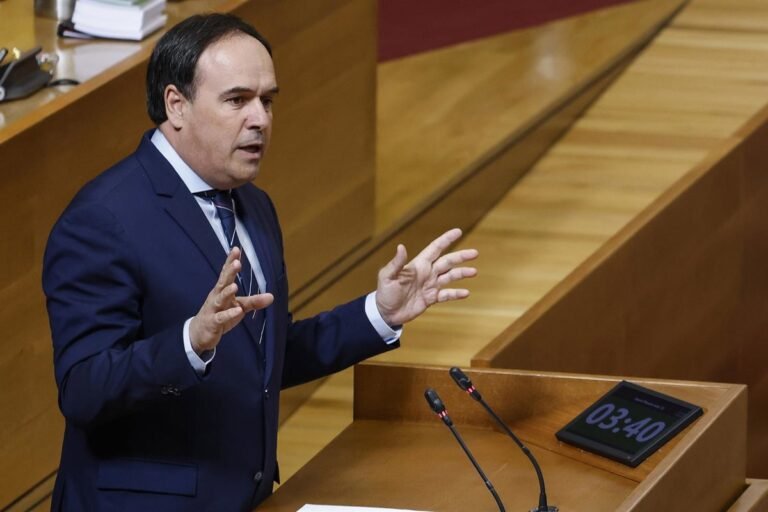
The Minister of Innovation, Industry, Trade and Tourism, Marián Cano, has explained that the Generalitat is working on an «impact map» regarding the effects of tariffs on the Valencian economy, in order to implement «almost surgical» support measures for affected companies, while advocating for the central Government and the EU to establish an aid fund.
The President of the Generalitat, Carlos Mazón; Minister Marián Cano and the Minister of Agriculture, Water, Fisheries and Livestock, Miguel Barrachina, met on Monday afternoon at the Palau de la Generalitat with social and economic agents, within the framework of the monitoring committee established to analyze the impact of the new tariff policy of the United States announced by President Donald Trump.
The meeting was attended by the President of the Confederation of Business Associations of the Valencian Community (CEV), Salvador Navarro; the Vice President of the Valencia Chamber, Vicente Folgado; the President of the Alicante Chamber, Carlos Baño; the General Secretary of CCOO PV, Ana García; the General Secretary of UGT PV, Tino Calero, and the President of Femeval, Vicente Lafuente, and the President of Ateval, Pepe Serna, among others. Representatives from sectors such as agri-food, metal-mechanical, automotive, footwear and components, ceramics, frits and glazes, energy, plastics, chemicals, textiles, furniture, toys, bathroom equipment, and products for children attended the meeting.
After the meeting, where a «message of calmness» to the population and companies prevailed, the Minister highlighted in a press conference the «maturity» of the Valencian productive sectors, while ensuring that they will «continue working on an impact map,» because «the actions we take must be almost surgical,» by «sectors, regions» and companies according to their «specificity.»
The Minister referred to the Generalitat’s internationalization plan, which will be worked on through «constant dialogue» to «analyze the planned actions and intensify those that are necessary.» She pointed out that some sectors have requested work on market diversification, while others have called for increased promotion assistance in specific markets.
«DE-ESCALATION» WITH THE UNITED STATES
Cano argued that Europe should maintain a firm stance, but based on dialogue, negotiations that lead us towards de-escalation with the United States,» and praised the CE’s proposal of zero tariffs for the industry because it is «the direction we should work towards.»
The Industry Minister advocated for an «aid fund» that could come from the revenue from the tariffs themselves and «specific aids to help maintain the level of exports that the Valencian Community has. She noted that a «very important» part should be contributed by the European Union, but the central Government collects 25% and she requested that «those funds be managed transparently and united, taking into account the autonomous communities and sectors, because that’s why we’re going to do that impact map work.»
Cano demanded that Europe «work on customs surveillance» and that productive sectors compete «on equal terms» against non-EU products. She also called for Brussels to progress in «administrative simplification» and «avoiding overregulation.»
Marián Cano urged the central Government and the European Union to «work on industrial competitiveness in the sectors» and «strengthen energy autonomy.» Therefore, she emphasized the extension of the life of nuclear power plants like Cofrentes. She also stressed the importance of «working on fiscal policy» to support companies.
ENTREPRENEURS CALL FOR UNITY
For his part, Salvador Navarro reiterated a «positive message» because «we have a very powerful exporting sector in the Valencian Community.» The President of the CEV stated that the most important response must come from Europe and that it should be «joint» and «considered.»
Navarro urged the central and regional governments to reduce «political tension in all aspects,» stating that with the opening to new markets, Europe must guarantee mirror clauses and reciprocity to the agri-food sector.
From the chambers, Vicente Folgado affirmed that they will continue «promoting the internationalization of companies» and called for «calmness because we have mature, strong sectors.» He also requested that «the European Union become more united.»
UNIONS SUPPORT THE RED MECHANISM
From CCOO PV, Ana García also called for coordination between the Generalitat and the central Government so that the different «funds do not overlap with each other,» and that they are also oriented towards workers. She advocated for activating the RED mechanism for productive sectors if they are affected by the trade war and requested that, if the Government implements it, the Generalitat articulates «some form of compensation» for the economic loss of workers.
García called for internationalization beyond the United States, strengthening strategic energy and industrial autonomy, and «developing a contingency plan by the Generalitat that is the result of social dialogue.»
The General Secretary of UGT PV, Tino Calero, advocated for reaching an agreement with the US to minimize the level of impact,» advocated for strengthening the European internal market, and stated that the union’s greatest concern is whether in the long term it could affect economic activity with job losses, although «we are not in that scenario yet.» He also called for the activation of the RED mechanism in case it reaches that point and emphasized the opportunity to «continue opening up the Valencian Community to investments from other countries.»
Tino Calero emphasized the need for «political parties in the entire State and the Valencian Community to take a long-term view» because we are facing a «State issue» that requires «broad vision from all parties in Les Corts, beyond those who have already aligned themselves with the Trump Administration.»